
Edition 25
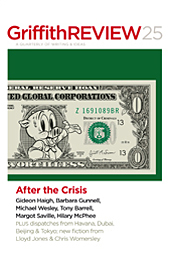
After the Crisis
- Published 1st September, 2009
- ISBN: 9781921520761
- Extent: 264 pp
- Paperback (234 x 153mm)
After the Crisis projects this new future, analyses the causes and historic parallels, examines the limits of the growth, and graphically reports what is happening on the front line around the world.
The corruption of banking is at the heart of the global financial crisis. Like an internet virus, it is a contagion that has spread with remarkable speed and destruction.
It has highlighted the weaknesses in the financial system and the economic order – the burden is not falling evenly.
In the lead essay acclaimed author and business journalist Gideon Haigh goes beyond the clichés and the predictable explanations to make sense of what is happening and why. His essay critically examines the practices of banking and the finance industry and the consequences for us all.
Other essays explore the limits of growth, the new meaning of globalism, the rise and rise of China, and front line reports of destruction and opportunities from Australia and around the world.
This is an important agenda setting issue of Griffith REVIEW – responding to the crisis that will reshape the world and anticipating what it might mean.
In this Edition
Cuba’s China syndrome
‘VIVA RAUL! VIVA Cuba! Viva la Revolución!' I awoke abruptly, stumbled over bottles at my feet and leaned over the wrought-iron balcony. A group below had emerged from the Confucius Institute, accompanied by a marching band that hit all the right notes at the...
Made in China
FOR THE FIRST in history, a communist country is in a position to bring down global capitalism. The Chinese Communist Party, if it were to sell the $763 billion in US Treasury bonds it holds, would trigger a massive devaluation in those bonds and...
Material or post-material?
THE AMERICAN POLITICAL scientist Ronald Inglehart argues that ‘the basic value priorities of western publics' shift in affluent times ‘from giving top priority to physical sustenance and safety, toward heavier emphasis on belonging, self-expression and the quality of life'. Inglehart calls this shift in...
No soft landing
'Tis against some men's principle to pay interest, and seems against others' interest to pay the principal.– Benjamin Franklin FOR A CONTINENT following the trajectory of the Great Depression, Europe exudes a surprising calm. In politics, no new phoenix is rising from the ashes of past...
A short prehistory of the future
Ah, the old questions, the old answers, there's nothing like them!– Samuel Beckett, Endgame Above all, the bourgeoisie produces its own gravediggers.– Karl Marx, Communist Manifesto FOR ME, THE history of the crisis begins with a sound. It's a chilly spring afternoon in Berlin in March 1990,...
The crumbling estate
NEARLY FIFTY YEARS ago I walked into the Dickensian editorial offices of The Age in Collins Street, Melbourne, to start a cadetship in journalism. Old men in green eyeshades sat around a horseshoe-shaped subeditors' table shuffling papers and grumbling. Rowdy correspondents, full of beer and arrogance,...
A new globalisation
WHEN THE DEEPEST economic crisis of the past fifty years finally ends, a changed world will be left in its wake. Capitalism will still be with us, but the new capitalism could differ substantially from the old. One key feature could be a new...
An outsider’s perspective
I RECENTLY PARACHUTED into the crucible of the American policymaking debate when I was invited to present alongside Robert Shiller of Yale at a private summit for Obama administration officials on the future of housing policy. There it struck me that the world I...
Stupid money
Shortlisted, 2010 Victorian Premier’s Literary Awards, Essay Advancing Public DebateAt particular times a great deal of stupid people have a great deal of stupid money... At intervals...the money of these people is particularly large and craving; it seeks for someone to devour it, and...
Chère Colette
AT IRREGULAR INTERVALS of between twenty and thirty years came great floods which were afterwards remembered as one remembers insurrections or wars and were long used as a date from which to reckon time, to calculate the ages of citizens or the term of...
The story behind sister’s new villa
STANDING IN MY in red coat, next to my luggage on the shining granite floor, I wait anxiously. Facing Gate 10, my eyes survey the cavernous space around me – the dramatic high ceilings, the bright futurist décor and the endless rows of check-in...
The fire this time
THE BUSHFIRE DEBRIS descends from the night sky with a strangely graceful motion, as if swimming. Leaves and twigs settle softly on the grass, on the flowering plants, on the divided planks of the veranda. A strip of bark a metre long describes a...
Tobias passing
TOBIAS FOX, VICE president of sales, arrived at our Canberra sales office by taxi. This was the last stop on his nationwide recession-chasing tour. For some weeks prior to his arrival, motivated by primal emotion, our team pored over spreadsheets, deals and opportunities, trying...
Slow burn
I WAS INITIATED into the Japanese investment-banking scene in a murky Tokyo izakaya in early 1988. Selling Japanese stocks to international investors was a new game – foreign securities firms had been permitted by the authorities to buy seats on the Tokyo Stock Exchange only two...
Windows on Lehman
EMERGING FROM THE subway I joined the crowds of Lower Manhattan, anxious about my first day on the job. The older buildings of the financial district were squat, tarnished sandstones puckered with sooty recessed windows. I walked towards a sense of openness and, turning...
Glimpses of heaven and hell
THE EIGHTH WONDER of the World had already been proclaimed well before the grand opening in Dubai of Atlantis, The Palm, in November 2008. The thirteen acres of artificial palm-shaped archipelago jutting out into the shallow waters of the Arabian Gulf featured a forty-two-acre...
The leaving of Pudding Island
I SPENT MUCH of 2008 in France, Spain and Greece, living among British expats, some of them relatives or friends and some complete strangers, all of whom had decided over the previous two decades that they no longer wanted to live in the country...
Greyfields
WHEN A SHOPPING centre is dying, its patronage slipping away, it is referred to as a greyfield. At this point annual sales have slumped below $200 a square metre. The centre slowly hollows, tenants are given notice and town planners swoop with schedules for...
Hedging bets on the future
IN 1985, I was a very junior lawyer in a blue-ribbon Sydney law firm. Over expensive cocktails at a function, the head of an overseas bank – the recipient of a freshly minted banking licence – flashed his gold Rolex and boasted that he...
A bend in the river
THE OPENING CREDITS of East Enders, the most watched television soap in Britain, show an aerial view of the River Thames snaking west to east through London on its way to the sea. The camera pulls out to reveal the distinctive skipping-rope loop where the...
Who’s that dancing with my mother?
WE WERE LIVING in Napier at the time. My father pulled the keys down from the hook in the kitchen and my mother asked where he was headed.‘Up the coast,' he said, and my mother went on slicing the ends off the beans for...
The real thing
OUR FAMILY'S NEVER been very good at ‘family'. When my nephew was conceived my sister and I weren't even speaking, some silly argument about my Northwestern Wildcats T-shirt she'd borrowed when she was sixteen which came back filthy weeks later, torn with a smudge...
The other side of silence
IT'S TRUE I wanted him dead and would gladly have done it myself. I wonder about the days before fingerprinting, before CCTV, forensic analysis and Google Earth: how easy it would have been to do away with someone. It's hard to believe to look...
Featured Contributors
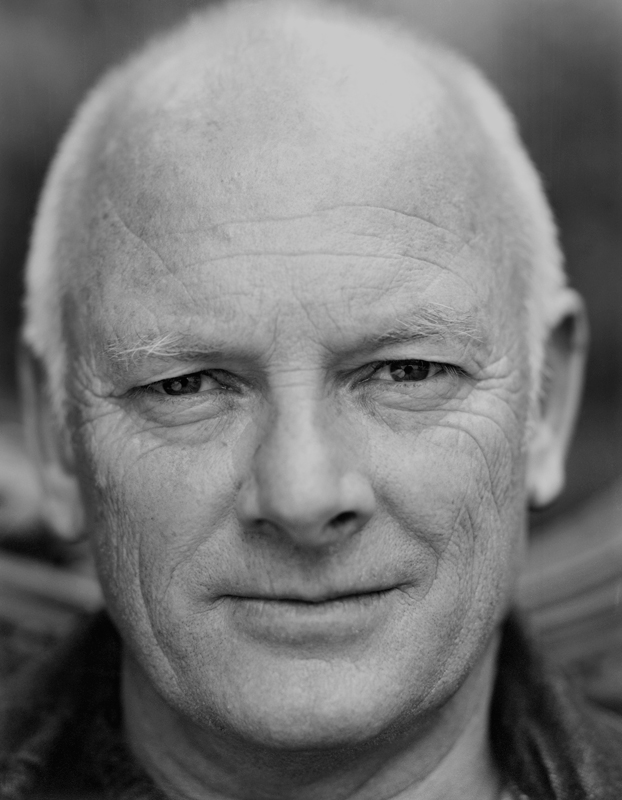
Lloyd Jones
Lloyd Jones co-edited Griffith Review 43: Pacific Highways. His novels include The Book of Fame, Mister Pip, Hand Me...

Catherine Harris
Catherine Harris’s short stories and essays have been published in Australia, Canada, England and the USA.She won the 2009...

Gideon Haigh
Gideon Haigh has been writing about sport, business, both and neither for more than thirty years. He has contributed...
Chris Womersley
Chris Womersley is the author of three acclaimed novels, The Low Road (Scribe, 2007), Bereft (Scribe, 2010) and Cairo (Scribe, 2013), all of which...
