
Edition 23
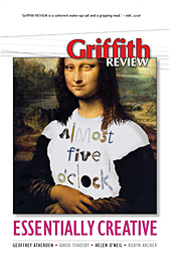
Essentially Creative
- Published 3rd March, 2009
- ISBN: 9780733323942
- Extent: 256 pp
- Paperback (234 x 153mm)
Essentially Creative draws on the insights and debates aired at the Summit to present a bold new agenda.
It argues that the arts, creativity, innovation and cultural policy deserve a place at the centre of the national agenda and suggests ways this might be realised.
The arts can no longer be regarded as decorative indulgences. More than ever they define who were are and how we are seen.
The skill, dedication and commitment required to produce enduring works of art needs to be celebrated and rewarded. The creativity which inspires those who produce and enjoy these works needs to be nurtured and encouraged.
Helen O’Neil ‘s lead essay argues that it is time to develop a new approach which goes beyond cultural nationalism. She draws on history and new research about the importance of the arts in national identity, economics and education, to suggest the way Australia could be transformed by truly valuing the arts and creativity.
Frank Moorhouse presents a manifesto for the imagination in an age of internet-induced anxiety, Nicholas Jose argues for renewed cultural diplomacy and Robyn Archer proposes a new way of thinking about risk.
Other essays, memoirs and reports by some of the best artists and writers in the country bring this transformation to life.
In this Edition
Ecologies of creative diversity
I AM NOT the greatest fan of the obligatory cultural tours that are increasingly anchored in the program of international conferences. In Vienna it would be to a Weinstube; in Durban a Zulu village; in Bergen perhaps a Viking museum. This time, in Hanoi,...
Bee Gees to Boat People
'WHAT IS IT about music education in Queensland?' This question is often asked when Australian music educators gather. Everyone seems to come from Queensland and everyone wants to go there. Perhaps part of the answer is that Queensland has a thirty-year history of compulsory...
A tale of two cultures
UNDERSTANDING OF ART can no longer be limited – as it often appears to be in the popular imagination – to something in a frame on a wall, or a piece of sculpture. Contemporary artists offer vaster, more engaged and more venturous resources than...
Industry that pays, and art that doesn’t
The critical attitude Strikes many people as unfruitful. That is because they find the state Impervious to their criticism. But what in this case is an unfruitful attitude Is merely a feeble attitude. Give criticism arms And states can be demolished by it. Canalising a river Grafting a fruit tree Educating a person Transforming...
Risky business in challenging times
TWO THOUGHTS SPRANG to mind as I dangled from the top of New Zealand's tallest building one sunny November morning. Two hundred metres above the street in a bright orange jumpsuit, there was no escaping the notion that a wrong move might have me...
In the gap between two ways of seeing
THERE WAS A time when, if asked what I did, I could reply without hesitation that I was an artist. In recent years, writing has taken up a greater proportion of my creative energy, but visual art is still the activity that gives me...
I had written him a letter
IF YOU'RE LOOKING for an example of how a classic literary text can speak to the present, you could hardly do better than Clancy of the Overflow. Banjo Paterson's poem of a century ago caught some Australian attitudes that are with us still. A sweet...
The river or the boat?
LIKE TINY TERRORISTS, a slew of toxic memories from the last twenty years swarm through my mind when considering Australian culture in the abstract. 2004: I attend a sponsors' dinner at the Melbourne Theatre Company, a posh affair with a well-known investment bank. I...
Manifesto for the imagination
These Arts, in their highest province, are addressed ... to the desires of the mind ... impatient of being circumscribed and pent up by the world which is about us– Joshua Reynolds, Discourse XIII (1723-1792) BECAUSE OF THE Henson controversy, I decided I should sit...
Art and sport – oh yes, and money
IN SEPTEMBER 2008, I was in London during the Olympics and the English press was rampant with joy that Britain had beaten Australia. Not shouting about beating Germany or France or Spain – countries with comparable populations. The front-page gloat was entirely about beating...
Ratbags at the gates
Shortlisted, 2009 Victorian Premier’s Literary Prize, The Alfred Deakin Prize for an Essay Advancing Public DebateON A JULY evening in Sydney in 1955, the nation's arts establishment gathered to celebrate the beginning of a new era in Australian culture. It was the gala opening...
Lyrics to imaginary songs
WHEN I THINK about poetry, about my need to read it and reflect on it – and even express the odd poem here and there as if a more direct voice had been switched on inside of me – I recall that it arrived in my...
Learning to write
THAT MAGNIFICENT OLD monkey-apple tree shading the butcher's shop lodged in my mind through a strange trick of memory. There I was in that slow, tranced state of childhood, staring up into its layers of shining green, deep in thought, the dry cleaners hissing...
The liberating discipline
THE RICH PROCESS of life is all about the acquisition and application of knowledge. How we manage our life attests to our own abilities and character as reinforced and nourished from our home environments, the reliability and quality of our formal education and the...
Never real and always true
IN 2003, AFTER more than a year in the grip of a major depressive episode, I consulted a doctor to discuss my condition. Alone in his surgery, I filled in a multiple-choice questionnaire, answering questions along the lines of ‘Do you feel worthless (a)...
Picking winners
YESTERDAY, AT THE races, someone I was making small talk with asked if I missed journalism. Two champagnes into the day, I was in an honest mood. ‘What I miss,' I said, ‘is getting published. I used to write four or five thousand words...
On annoying a shock jock
I USED TO have a boring job. Not a terrible job, just a boring one. Everyday, I had to get to Central Station by 12.30, walk up Chalmers Street to the Australia Post building and my desk at Media Monitors. I would clock on...
Willy and Roy
ROY PRESTON LOVED loved the smell. When the amplifier's valves warmed up: their filaments glowing orange, they gave off a sweet musty odour. He opened the cabinet doors just to inhale it. Who'd have thought gramophones could be so seductive. Roy smiled and swung...
Synergy and serendipity
I KEEP LOOKING for a term – the opposite of ‘a perfect storm' – to describe the synergy when a series of good events and people accidentally come together to create an outcome that none could predict. That is what happened as a result...
Notes from the feral edge
SUNDAY NIGHT ENDED with a feast of dumpstered strawberries, eaten at banquet tables piled high with bark and leaves; music that might have once been '80s pop lurched through the crowd of diners, jostling sweaty boys with handlebar moustaches and girls in low fedoras....
The unexpected idea
ON A WINTER'S day in 1869, Russian scientist Dmitri Mendeleev sat at his desk trying to write a textbook on chemistry. Almost from the start, he had had difficulty structuring the material. Sixty-three elements were known at the time, a mixture of solids, liquids...
Visionaries, or The Cello of Katerina Valentine
FIRST, THE DIRECTOR made a pitch. The film finance people told him to get a scriptwriter. ‘I've got a vision,' he said, but they told him he needed a script as well as a vision or otherwise they wouldn't fund the film and they...
Notes to a biographer
INK THIS: IN the afternoons he would begin to drink – not very much, but steadily – to gauge the state of his soul, he said. He also said he could not calibrate the soul by thinking too hard, or by measuring it according...
Sunlight
FOR THREE DAYS straight, Anna had stayed inside, limbs aching, senses dulled. She'd heard Tom come and go – mainly go. She lay on the bed, watching the fan slowly spin above her. The fever had gone. She felt drained but light. Hungry. Downstairs...
Featured Contributors

Kim Mahood
Kim Mahood is a writer and artist based in Wamboin near Canberra. She grew up in Central Australia and on...
Jenny Sinclair
Jenny Sinclair is a Melbourne writer of fiction and nonfiction. Her books are Much Ado About Melbourne (Affirm Press, 2015) and A...
Rosie Scott
Dr Rosie Scott is an internationally published, award-winning novelist.Her latest novel Faith Singer was included in an international list of ‘50...
James Bradley
James Bradley is a novelist and critic. His books include the novels Wrack, The Deep Field, The Resurrectionist and Clade,...
