
Edition 24
Participation Society
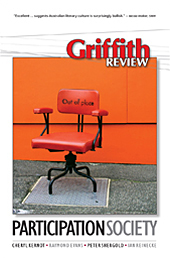
- Published 2nd June, 2009
- ISBN: 9780733323959
- Extent: 264 pp
- Paperback (234 x 153mm)
This is not a moment for despair. Participation, openness, collaboration, innovation, sustainability and social capital are the new buzz words.
In the lead essay Cheryl Kernot argues that there is a need for swift and decisive action to nurture social entrepreneurs who have the agility and imagination to respond to these challenges.
New forms of participation learn from the past, and range from cyber-activism and micro-loans to a fundamental rethink of the nature of democracy in an information-rich world.
An outstanding collection of writers conjure new models to shape the future and make business as usual a thing of the past.
In this Edition
From an unconscious state
SOMETHING IS MISSING from the debates about teaching history in Australian schools, even though their explosive, raw and at times distinctly personal quality must surely be a good sign. If we are not prepared to shout and bang on tables over history and kids,...
Must film be fiction?
‘PRIMARILY, WE HISTORIANS write books – and academic articles,' Yale historian Dr Jay Gitlin said in a history documentary we made together in 2006 called A Frontier Conversation. On our ‘Exchanging Histories' tour in the Northern Territory, the high-achieving American historian grew hostile to the...
From me to we
IMAGINE THE GREAT Hall at the University of Sydney, packed row after row with teenagers, being asked to write on a postcard what they want most for their lives and the world they are inheriting from their parents. The pens and pencils in their...
Dark times
This is to let you know that I have arrived safely in Australia and am being detained in immigration detention. I am currently unable to telephone or write a letter to you but as soon as I can I will be in touch. I...
A woman’s place …
THE FEDERAL GOVERNMENT'S commitment to establish a new Indigenous national representative body provides Indigenous Australia with a unique opportunity to galvanise the potential of liberal democracy to reshape the way we do business, both with the state and with each other.We know that establishing...
Been there, done that, still hoping for more
LET THE READER beware. Whilst this essay is, I hope, objectively written, it is committed. By that I mean two things. First, it is aspirational. It is driven by a fervent hope – and by far more cautious optimism – that Australia can develop...
When the whistle is blown
IT WAS EARLY 1996, and getting late in the evening. Somewhere in a nondescript building in central Canberra, I was prowling a largely empty open-plan office, killing time while an Australian Federal Police investigator and I waited for yet another police officer to come...
Monitory democracy and media-saturated societies
THERE IS A need for a fundamental revision of the way we think about democracy in our times. An epochal transformation has been taking place in the contours and dynamics of representative democracy. From roughly the mid-twentieth century representative democracy began to morph into a...
Consumer democracy
THE IDEA THAT it is the primary function of elected governments to raise the disposable income of their citizens is the great unwritten understanding of modern Western democracy. ‘The social contract of Cold War liberalism' one commentator noted is, ‘a state-sponsored guarantee of private...
Real communities
THE FORMER PRIME minister once dreamed of Australia as a nation of shareholders, enriched by their participation in the adventure of capitalism. Properly conceived, that is certainly one form of social engagement. If it looks a little less appealing to the punters today than...
A quiet revolution
Once in a rare while the fundamental architecture of a significant part of society shifts. Over the last two and one-half decades the organisation of the social half of society, led by social entrepreneurs, has done so.– Bill Drayton, Ashoka, 2002 LIFE HAS A way of...
Tribes of Berlin
THE EARLY DAYS in a new city always feel similar to snorkeling, or taking hallucinogenics, or lucid dreaming – where nothing is fixed in place or context, where people and objects drift by as if disconnected from reality, where there are no memories.And so...
Welsh rarebit
The past in maiming us, makes us. – Frank Bidart[i] ON MOST DAYS when I was very little I would be pushed in a pram past a massacre site on the way to my grandmother's house. Or perhaps it was the site of a stand-up...
Seeds of hope
WHEN I FIRST started going in and out of Jordan three years ago, my well-honed multicultural sensibility was shocked by what I could only hear as virulent anti-Semitism. Israeli and Jew and Zionist were terms of abuse used by all but the most cosmopolitan....
When elections need protection
THE CALL CAME at the very end of my four-hour shift on election day 2008: ‘Ma'am, I'm calling from Missouri, where I'm a poll worker, and my sister tells me – she's over at another polling place – there's a man there giving $100...
Assemble at home
ONE AFTERNOON IN late July 2003 I turned up at a café in Brunswick Street Fitzroy to have coffee with a man. I carried, for reasons still partly obscure to me, a small orange case – a child's reinforced cardboard 1950s school bag –...
Working on big issues
FOR A COUPLE of years in the mid-1990s, I worked out of an office overlooking Times Square. Sounds of the midtown-Manhattan traffic, many floors below, were screened out by huge windows, which, when it grew dark, offered spectacular views of the neon advertising signs...
Voice of the people
WE LOVE A good hoax. When it was revealed that Keith Windschuttle, editor of Quadrant, had accepted a bogus article on genetic engineering, the wide coverage provoked debate about Windschuttle's criticisms of historians for flawed footnotes. Comparisons to famous hoaxes were made, and Windschuttle's opponents...
A story of the digital generation
'YOU ARE LISTENING to sin,' said the radio announcer. That was a few years ago now and I remember thinking I must have misheard. The music was also a bit odd, plunging into bad taste and then getting good again. As it turned out...
How cyber-activism changed the world
I can't thank you enough for providing the tools I've always wanted for social change. With MoveOn, I feel like I have a voice in the world and an organisation fighting for the same things that are important to me. As a working professional...
Featured Contributors

John Keane
Professor John Keane holds a Chair of Politics at the Centre of the Study of Democracy (Westminster University), which...
Megan Davis
Megan Davis is the Balnaves Chair in Constitutional Law and Pro Vice Chancellor Indigenous, UNSW, and Director of the...
Maria Tumarkin
Maria Tumarkin is a writer and cultural historian. Her latest book is Axiomatic (Brow Books, 2018). She teaches in...
Alan Attwood
Alan Attwood has had a long and varied career in which he has tended to specialise in not specialising.For...
