Destination: Adelaide

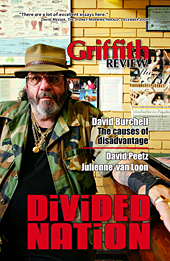
From Griffith REVIEW Edition 15: Divided Nation
© Copyright Griffith University & the author.

| Print | E-mail

Bookmark and Share

Download the complete article PDF

Tracy Crisp's biography and other articles by this writer


In the days when seatbelts were optional and parents smoked in the car without a second thought, Adelaide was a destination. We visited my grandfather. He gave us bags of copper coins and we spent them in department stores. Adelaide had movies and music, trains and a tram. It had traffic lights and Hindley Street and Sportsgirl in the Mall.

I came to university and thought I had arrived. I had black stirrup pants, a paisley shirt, new sunglasses and my own cheque-book. I bought my first carafe of red. On hot days, I went to the Art Gallery. I saw Michael Hutchence, Bono and Annie Lennox. Live at Memorial Drive. Hoodoo Gurus in pubs. But only four years later, degree complete, the department stores weren't that big and Hindley Street wasn't that long. Jobs were too hard to find, too easy to lose.

I left my destination, and I was not alone.

Demographer Graeme Hugo says that "substantial" net migration losses from South Australia "reached record proportions" in the 1990s. We wanted adventure, higher incomes, jobs. We didn't know we were part of a trend which would have a significant impact on the growth and structure of the state. Hugo says "the effect of the net loss interstate has been amplified by the fact that it disproportionately contained the young workforce and economically productive groups" including a high proportion of young women.

Over the last decade, South Australia's population growth has been the slowest of all states except Tasmania. And, in a greying world, South Australia is greyer than most. Don't look at the statistics. Just look around.

What if these trends continue? In Series B of the Australian Bureau of Statistics' most recent Population Projections, the South Australian population is projected to peak at 1.65 million in 2032, then begin to decline and further age, so that by 2051 there will be around 1.58 million people living in South Australia, and around 30 per cent of us will be over sixty-five (compared with 15 per cent over sixty-five in 2004). Population projections are rooted in assumptions and are not intended as predictions or forecasts, but the scenario is not unrealistic. Those are not church bells you can hear – they're alarms.

In its 2003 paper, A Framework for Economic Development in South Australia, the Economic Development Board quotes Tom Peters as saying: "You can't shrink your way to greatness". Noting that "economic development has population consequences and vice versa" the board recommends "that the government formulate a State population policy as a matter of urgency".

Hugo writes: "While zero population growth and slow growth does not necessarily mean lower prosperity, the spectre of a declining workforce and population, and of the evolving age structure in the state are issues of concern. Accordingly, what is needed is a policy which weighs up the economic, social and environmental consequences of a range of population futures and selects a scenario which is most beneficial to all of these areas."

In 2004, the state government released Prosperity Through People: A Population Policy for South Australia. In his foreword, the Premier states that the population trends are considered " key barriers to the State's continued economic and social development". He says: "We must refuse to accept the inevitability of population decline and recognise the need to respond to the ageing of our population. I am confident ... that we can increase our population – and protect our environment – by ensuring development takes place within an overall framework of sustainability." The policy sets a population target of two million by 2050, with strategies focused on migration ("new" migrants and expatriates); fertility and ageing, and striking a better work-life balance to give flexibility and support to parents and mature-aged people; and labour force and skills development. This feeds into the government's strategic plan, Creating Opportunity, designed to create a dynamic, inviting state.

A destination and a place to stay. A place to which people will return.

In June 2006, the Strategic Plan Audit Committee rated progress of the population target as "unclear" (which means no data or no new data are available or measurement is problematic). The overseas migration target was rated as on track to meet the target in the time-frame, but there was little or no movement made on the interstate migration target. The committee reported that "the target will ultimately prove to be unachievable unless urgent and extensive actions are taken".


I LEFT ADELAIDE ONE YEAR AFTER I GRADUATED, one day after I married. We had one-way tickets and an idea that we wouldn't return. We didn't tell my mother-in-law that – there were tears enough – we said "five years, tops". And we left our half-finished boat in my father-in-law's shed. "We'll be back to pick it up," we said.

But my mother died in a car accident, and I found her absence too hard to understand. I tried for a few more years, but in the end I had to come back to the places she should have been, but was not.

I thought the stay was temporary, and that I would leave again. I thought we would buy a Norwood maisonette (an investment – Adelaide real estate was cheap), give it a lick of paint, grab the boat and be back on our way. But we stayed. It wasn't a decision we made – we just stayed. We read the letters then emails from our friends, and caught up with them for lunch when they came back from Melbourne for Christmas or brought fiancés home from London to meet their mums. They continued not living here, and we continued to stay.

Charles Landry, cultural planner, "international authority on city futures" and the state's second Thinker in Residence, estimates that, of Adelaide's one million inhabitants, "perhaps 250,000 are underachieving". In his report Rethinking Adelaide: Capturing Imagination, he says that "in Adelaide people with a high level of ambition find it hard to realise their potential. It feels as though the pool of risk takers and thinking people is too small to stimulate people to achieve more."

And more than the frustrations and thwarted ambitions of the entrepreneurial, professional and middle classes, Landry says that some of Adelaide's inhabitants are underachieving "desperately" and "leading a life that both drains them and Adelaide".

In Extending Opportunity to All: A Blueprint for the Elimination of Poverty in South Australia, the South Australian Council of Social Service notes that "almost a quarter of all South Australians are living in poverty ... South Australians do want prosperity, more and better job opportunities, a better education for their children, and health and wellbeing. More than these, they seek to live in an embracing and genuinely inclusive community where the same opportunities are extended to all. The greatest barrier to this for South Australians is poverty."

Unlike the rest of Australia, where the gap between rich and poor has widened, "South Australians have become more equal in recent years, not because of the rising affluence of the worst off, but because of the declining relative standing of the best-off," says Dr Peter Travers from Flinders University. Landry explores the psychology of a city which allows, might even encourage, its inhabitants to "underachieve". Our culture, he says, is one of "constraint". In Adelaide, there is "a sense of trapped energy. A preference for order and perfectionism for which the Light plan of the city stands as the supreme emblem."

Someone once said to me: "Oh, I lived in Adelaide for a while, it was very repressed, all those lines on the footpath at the bus stops ... and everyone stood in them!"

I didn't remember painted lines at bus stops. "But if the lines were there," I said, "why wouldn't you stand in them?"

She blinked, but didn't laugh.

"Yet it is a place that knows it needs to contrive opportunities out of nothing in order to survive with few natural resources," Landry writes. "So within this settled order creativity is occasionally allowed to burst out, exemplified by the Dunstan era."

At the moment, though, we are stifling our creativity and entrepreneurship. "A major challenge for Adelaide is confidence and the need to feel more relaxed about itself and less defensive. It could start by no longer promoting itself with adjectives such as ‘sensational Adelaide' and projecting itself simply as ‘Adelaide' – and allowing that to speak for itself."

Oh, yes please. That would be great.

"Cities can import resources and they need to; they can attract outside talent to refresh [their] inner gills and they have to; but most of all they need to achieve endogenous growth," he says.

"Harnessing the creative potential of local people has to be the defining core of Adelaide's reinvigoration." He put that bit in bold.


Array ( [option] => com_content [Itemid] => 34 [catid] => 82 [id] => 165 [lang] => en [view] => article [layout] => default )