Stupid money
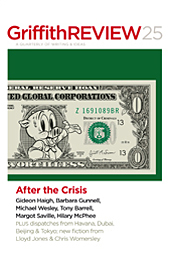
From Griffith REVIEW Edition 25: After the Crisis
© Copyright Griffith University & the author.
Written by Gideon Haigh
Download the complete article PDF
Gideon Haigh's biography and other articles by this writer
At particular times a great deal of stupid people have a great deal of stupid money...At intervals...the money of these people is particularly large and craving; it seeks for someone to devour it, and there is a ‘plethora'; it finds someone, and there is ‘speculation'; it is devoured, and there is ‘panic'.
– Walter Bagehot, ‘Essay on Edward Gibbon', 1856
In the late 1990s, when I was busily employed writing the history of a bank, one of the choicest vantage points was the foyer of its skyscraper each morning. This would begin filling with employees around seven, while remaining strangely devoid of hurry or flurry; there was a sense of deep solitary deliberation, of people already at work in their minds long before they arrived at their desks. Although the suits were smart and the outfits expensive, there was little ostentation. The standard accessory was not a slimline briefcase but a gym bag: lunch was for wimps; running and pumping iron were preferred.
Business had such a buttoned-down air that the outside world was easy to forget. One morning, late in August 1998, my first appointment was with a veteran fixed-income executive. It happened that, overnight, the Dow had swooned almost a fifth in response to Russia's decision to suspend coupon payments on its rouble bonds; even as we spoke, the default was wreaking havoc on local equity markets. Not that you would have known it. Only occasionally, as he fielded questions about note and bond issues from days of yore, did my interviewee turn to one of his screens and check prices, remarking lightly at the money being lost by everyone, including himself. His sangfroid was impressive; in the span of our conversation, his wealth must have been lightened by a million dollars or so. But, as I learned, he wasn't unusual.
Even as stocks plunged, yield curves contorted and interest-rate spreads blew out through the afternoon, the difference in the trading room from a normal day was difficult to discern. Save for a few more chagrined glances and amused asides, the hum of quiet industry was hardly disturbed. Eleven years earlier, I had watched foam-flecked operators roaring themselves hoarse on the floor of the Melbourne Stock Exchange during the share-market crash; now, it seemed, crisis could be bridged by recalibrating a few models – a hedge here, a haircut there, a little restructuring everywhere.
Perhaps it was different elsewhere – I'm sure it was. Yet it also felt like a motif of an era in which financial upheaval was a routine, while remaining oddly distant and unreal, like an occasional disconcerting thud in another room heard through the wall. Capitalism decorated itself with a daisy chain of disasters: the Tequila crisis, the Asian meltdown, the defaults of Russia and then Argentina, the rout of the dotcoms and then the telcos; the disgracing of Enron, WorldCom, Tyco and even Martha Stewart; Australia filled its own corporate pillory with the likes of FAI, HIH and One.Tel.
Yet, somehow, these misfortunes always seemed to befall other people. Sooner or later, central bankers stepped in, poured money on troubled markets, and the moment passed – until, one unexpected day, 15 September 2008, it didn't. On that day, the 158-year-old Wall Street investment bank Lehman Brothers, driving force behind RCA and the birth of television, patron of enterprises from Pan Am and TWA to Sears, Roebuck & Co. and Macy's, slid into bankruptcy under a burden of debt rendered insuperable by the collapse of the American housing market.
That day, a day we are still living through, and will be living through for some years to come, an old saw was varied. Owe the bank a million and you have a problem, it used to be said; but owe the bank a hundred million and the bank has a problem. To this now add: when millions owe trillions they have no hope of paying back, the government has a problem.
THE CREDIT CRISIS IS ALREADY quantitatively and qualitatively different to those earlier misadventures, to which we grew so inured. Trading rooms are again subdued, but it is the quiet of paralysis, apprehension about what else might lie in wait on battered balance sheets, anxiety at mushrooming deficits that imperil national credit ratings. Industry is straining to adjust to a world of scarcity, both of credit and of consumption, and global trade is more circumspect for the apparently long-term economic realignments ahead.
Politicians and central bankers have stepped in but their monetary-policy party tricks have so far failed to rekindle confidence, while one bank bailout has followed another and a succession of stimulus packages has been unable to revive demand. Indeed, it's partly the central bankers' solutions to prior problems, their repeated irrigations of illiquid securities markets that precipitated such a promiscuous wastage of credit, in particular the incomplete resolution of the currency collapses twelve years ago in Indonesia, Thailand and Malaysia. Bulwarking themselves against a repeat of events, Asian economies between 2001 and 2007 poured US$5 trillion in savings into funding a yawning American current-account deficit. This allowed the central banks of the OECD to keep interest rates artificially low, and spenders to surfeit themselves.
Booms, too, are usually associated with mirages, speculations, peculations. But the boom we are doomed to repent was as solid as bricks and mortar, involving the satisfaction of that most familiar of yearnings, home ownership, and driven by that uniquely human quality, optimism – the belief, fundamentally, in a perpetually brightening future. The bust, meanwhile, has prostrated an industry, finance, that had prided itself on consciousness and control of risk, on non-stop growth and innovation. The giants of Wall Street have already been humbled; for Europe's banks, which have recognised just a fraction of an estimated US$1.1 trillion in losses, that day is coming. Australia's better-capitalised banking sector has so far absorbed the shocks from abroad, but perhaps a decade's deleveraging lies ahead: according to the Asian Development Bank, global financial assets depreciated last year by roughly $50 trillion – equal to the world's economic output for a year. The interconnectedness of the global economy has for years been a matter of marvel; it has in fact proven more far– and deep-reaching than anyone acknowledged, with Iceland near-ruined by the carelessness of its banks in Britain, the Congo slowed almost to a standstill by Chinese investors repatriating capital, and bank collapses from Spain to the Caribbean.