The third and fourth countries

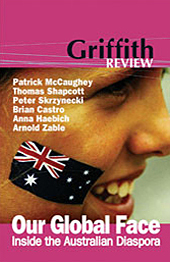
From Griffith REVIEW Edition 6: Our Global Face
© Copyright Griffith University & the author.

| Print | E-mail

Bookmark and Share

Download the complete article PDF

Catherine Cole's biography and other articles by this writer


In the frontispiece of my next novel, La Tombe de Thu Le, I have used a quote from the British writer and historian Ronald Fraser: "What actu­ally happened is less important than what is felt to have happened. Is that right?"

Set in Hanoi, the narrative journeys with a French woman tracing a 100­year family connection with Vietnam. Her great-grandfather was the supervising engineer on Hanoi's French-built Doumer Bridge which is now called Long Bien. Like many French colonists, my fictional family stayed in Hanoi until 1954 and left during the Battle of Dien Bien Phu.

Why have I, an Australian of British background, written about Vietnam from a French woman's perspective and not an Australian one? Australia does, after all, have a history with the place. The answer is a complex one, grounded in an obsession I've had since I was very small.

France.


I BLAME MY FASCINATION ON A CHILDHOOD OF MADELEINE BOOKS, which led to Colette and Violette Leduc, Balzac, Zola, Flaubert, Proust, Stendahl, French new wave cinema and French sentimental songs such as La Mer and J'attendrai, with which I bore my friends sometimes at dinner parties. It is all linked to early memories of school, cicada-loud summer days and a teacher once saying: "If Captain Cook had been beaten by La Perouse we'd be speak­ing French today." "So?" I remember thinking as flies circled lazily above our desks. "What could possibly be wrong with that?"

Perhaps this kind of idealised fascination is an inevitable by-product of migration. The children of migrants inevitably fall between the cracks. Our understanding of nation and citizenship are stunted in some way – because we hear too much of somewhere else.

Being Australian. What is that? I always suspected it had something to do with the world beyond the fibro house my parents built with the help of other migrants they met on the ship out, with bush, snakes, wild horses and stockmen – images reinforced when the Man from Snowy River took part in the opening of the Sydney Olympic Games. A vast Aboriginal country, veneered with Europe, it never was and never will be mine.


THE LITERATURE OF EMIGRATION HAS BEEN CALLED A LITERATURE OF LATENCY. In a state of bereavement and impotency, the writer attempts to reconcile him or herself with the old, the new, the lost, the discovered world. The imaginary world of the migrant's child begins with what was left behind. In my case, it was Yorkshire's moors and coalmines, parkin – a kind of sticky gingerbread indigenous to Yorkshire, and an image from my mother's child­hood home of a bricked-up passage to the local abbey – a relic from Henry VIII's dissolution of the monasteries. My parents recreated their Yorkshire garden allotment on our quarter-acre block, growing vegetables they'd only dreamed of and sending photos of them to the family at home.

The new country for which parents uprooted, leaving behind families, friends and rabbits in hutches, isn't the child's either. More Yorkshire than the Yorkshire they left behind, my parents endlessly recounted pre-war memories with neighbours with whom they swapped surplus fruit, Italians locked in the Calabria of 1953. You see the same in Vietnam today. The over­seas Vietnamese, Viet Kieu, a term used with a slight sneer, go home for Tet wearing a look that gives them away: Western, more affluent, schooled in the ways of another, alien, place where they cling to the Vietnam of 1975.

But in other places – our third countries – rests a choice. If you don't belong in the old or the new you can always adopt.

As I observed the Vietnam War during my adolescence, I was driven to anger. As an Australian, my country was responsible for the deaths of mil­lions of Vietnamese. The war's images followed me everywhere I went – to London for a year and back home again. And then in April 1975, Saigon fell.

Why then haven't I written about Australia's Vietnam? The only answer I can give to that is: give me time.


IN 2002 I WAS AWARDED A RESIDENCY IN THE KEESING STUDIO IN PARIS. While there I would trace France's history in Vietnam and examine the Viet­namese diaspora in Paris. Researching and writing in another country opens the kinds of doors on which writers love to knock and I found myself using the stories from the day-to-day experience of being a researcher as much as those of the research subject. I met people who had worked in the Pasteur Institute in Hanoi, some had been administrative staff to Vietnam's last emperor, Bao Dai, while others had been born and schooled in Hanoi, leaving, as my novel's family does, just before the French defeat at Dien Bien Phu.

In Aix-en-Provence's colonial archives I spent hours examining photos and determining with a patient librarian that on France's colonial maps the colonies were usually shaded purple. In Paris I visited galleries and ceme­teries, the archives, libraries, newspaper offices. Some librarians were like Cerberus guarding the gates of Hades from nosy foreigners, others were more welcoming. But they all posed the same question: Why was an Australian, and one of British background at that, researching French colo­nial history? What claim did I have on that?

And so it is with images of Vietnam – some let us into their stories, others pose barriers. Like most Australians, I discovered Vietnam through the war we call the Vietnam War – the Vietnamese call it the American War. My first engagement with the country is another memory of school. I was sitting with some girlfriends during recess. I recall we were all drinking chocolate milk and we were talking about what we'd do if our (as yet to be attained) boyfriends were conscripted. I think we even mentioned food parcels and socks. Our TVs had shown the troopships sailing away, Save Our Sons mothers, protesters throwing marbles. Soldiers, jungles, aeroplanes. Flames. What if I'd been a 20-year-old man? I asked. What if my brother had been called up?

Sometime later I earned some money selling door-to-door magazine sub­scriptions and one day interrupted – I realised later – the afternoon sex a young conscriptee was enjoying with his girlfriend. He came to the door in his inside-out underpants and told me a subscription was no use to him as he was going to Vietnam the next day.

Then there were moratorium marches. Once I walked beside an old wharfie who talked to me about the International Brigade and Franco. I remember his stories much more clearly than the speeches of the day. There was a crush outside Wynyard station and the odd sensation of being pushed back hard against glass. I remembered my mother's cautionary tales as I sat down on the road, that cold gave you piles or menstrual pain. In those early encounters with Vietnam were sown the seeds of an exploration from a very different perspective than that of a westie teenager outside Sydney Town Hall.


Array ( [option] => com_content [Itemid] => 43 [catid] => 109 [id] => 402 [lang] => en [view] => article [layout] => default )