Of the bomb

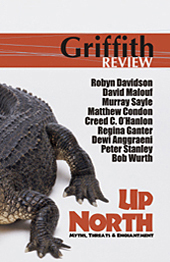
From Griffith REVIEW Edition 9: Up North
© Copyright Griffith University & the author.

| Print | E-mail

Bookmark and Share

Download the complete article PDF

Matthew Condon's biography and other articles by this writer


He was a small old man and he sat alone in the tram. It was late July and very warm and the tram was making its way through the southern suburbs of Hiroshima to the ferry terminal for the sacred island of Miyajima. The old man wore a large, floppy brimmed canvas hat and a beige safari suit. He cradled in his lap a little carry bag. He had been watching me since I boarded near the A-Bomb Dome and sat on a bench opposite him. As the tram emptied, stop by stop along route 2, he continued staring through his pair of enormous, thick-lensed spectacles.

On occasion, I glanced at his kind, worn face and realised there was something not quite right with it. It was not something immediately obvious, but it was curiously out of alignment. His left eye was smaller than his right, the difference exacerbated by the thick spectacle lenses. The cheekbone, too, below the pinched eye, was flat, in defiance of the other across the bridge of his nose, which was round and full. It looked, to me, like a face that had suffered an accident a long time ago, and the imperfections were far away, on the horizon of a long life.

At one point, it was just me and the old man in the tram, and this was when he rose slowly and sat beside me. "Where are you from?" he asked. His voice was thin and his English heavily accented but clear.

"Australia," I said, turning to him.

He stared down at the carry bag in his hands.

"Are you a soldier?" he asked.

I laughed at the unusual question. "No," I said.

"I remember the Australian soldiers in 1945," he said, "with the hats." He folded up one side of his canvas brim, making an impromptu slouch hat. "Very nice," he said, smiling.

Australian soldiers had taught him to speak English at a school in Hiroshima, he said, after the war. He had been born in 1928 and had been a "ship man" when he was younger. He gripped an imaginary ship's wheel with his old hands and motioned to steer from left to right.

Then he said, unexpectedly: "I am of the atom bomb."

He rummaged in his carry bag and I noticed that the texture of the skin on his left hand was very smooth, an oddity consistent with his eye and his cheekbone. He was an old man divided into two sides. Eventually he produced a thick blue booklet, the size of a passport. I had read of these books carried by A-bomb survivors. They were medical record books.

"I am going to the hospital," he said, holding up the book. "Every week I go to the hospital."

He tapped his knee with the book before returning it to his bag.

"I was visiting Hiroshima on that day," he said, recalling August 6, 1945. "The atom bomb. Wooosh." He raised a bunched fist and flicked his hand open to indicate the explosion.

He looked at me with that crooked face and smiled again.

"I am of the atom bomb," he said.


I HAD COME TO JAPAN TO RETRACE THE STEPS of the legendary Australian journalist Wilfred Burchett. As a young reporter, and in that early grappling for mentors and models, for a guide into the architecture of journalism, I had known of Burchett for a singular achievement – he was the first Western journalist into Hiroshima after the dropping of the atom bomb. In the 60 years since Burchett filed his famous report, "The Atomic Plague", for the London Daily Express, it has probably remained the greatest individual newspaper "scoop" of the 20th century and into the millennium. It's impossible to know now to what degree Burchett was writing for history, but you get the feeling, from the opening line, that the young reporter from Victoria had an eye to posterity. "I write this as a warning to the world."

Burchett was almost 34 years old when he made his incredible solo journey from Tokyo to Hiroshima to bring the facts of the bomb's devastation to the world, as he put it. At tremendous risk to his personal safety, he took the long train journey south, travelling in that delicate period between the dropping of the bombs on Nagasaki and Hiroshima, and Japan's official surrender.

It struck me, as a journalist and a novelist, that this act was the stuff of dramatic fiction and that one day I would write a novel about this chapter in Burchett's life. The story had everything – war, flight, danger, heroism and, at the centre of it all, one of the defining moments in human history. I made some cursory notes.

Years later, I was browsing through a second-hand book stall at a Gold Coast flea market when I came across an extremely battered copy of one of the prolific Burchett's polemic books – This Monstrous War. The book dealt with the Korean conflict. By now I knew more about Burchett's life, his evolution into a "radical" journalist and his ability to polarise readers, colleagues, even governments. He was accused of being a communist spy, a traitor, a fabricator. His own country, for a time, refused to grant him a passport and re-entry into Australia. Since Hiroshima, his reputation had wobbled and stumbled.

I developed a theory, too, that the impact of what Burchett saw in Hiroshima, and the scoop itself, changed something inside of him: that the dropping of the A-bomb was a schismatic moment for mankind, and also for Burchett's psychology. The theory had no basis in fact. It was the fancy of the novelist, trying to find a way into the head of an undeveloped character. I was already knitting a person called Burchett with the grand, subterranean themes of an unwritten novel. The A-bomb divided the 20th century. So, too, would atoms split in the mind of my Mr Burchett, altering his view of the world, perhaps sending a hairline fracture through his soul. All these muddled musings, you hope, eventually break through the scrub and into a clearing. It is the great gamble of writing fiction. Blindfolded, you fire an arrow and hope to hit a very small target. Already, I had left much of the actual Burchett behind.

When the Iraq conflict broke out post-September 11, 2001 and the world witnessed the manipulation of the media by the superpower that is America, and truth, as they say, became a casualty itself as the war rolled on for months, and then years, I kept thinking of Burchett and Hiroshima. In that instance, his purpose was the pursuit of truth. That purpose may have been tangled up with notions of future fame and accolades, of promotion and financial reward, of changing the world. It is the dichotomy of reporting – at some points in your career you write for the public, but you also write for other journalists. This is what I got, you're saying, and you didn't.

It was a dangerous, renegade act (often the prerequisite for defining moments) for which Burchett was later vilified. In some ways, it went to the very definition of reporting. In the context of the contemporary world, with television and print journalists "embedded" with US troops invading Iraq (the word itself, embedded, so quickly redefined and attached to the media, yet still reminding me of a splinter, and its associated irritation), I thought of Burchett and that warm September in 1945 when he walked through the ruins of Hiroshima with his notebook. I felt that something had been lost. That we'd mislaid something very important about, or within, ourselves. That in modern times the media was like sediment, layer after layer of it, rolled out over feeling and empathy and rage and all those human responses to things that happen in the world. That everything would set like sandstone, and one day, beneath the many stratas, a little fossilised truth would be found, embedded, fragile as a mosquito.

I'd bought This Monstrous War for a single dollar, but didn't realise until I got home that it had been personally inscribed by the author. His best wishes and signature were scratched onto the title page in blue ink some time in the 1950s.

When you begin a writing project you accept, beyond logic or reason, all manner of superstitions, totems, coincidences and signs. You believe they will help guide the arrow. I liked the idea that Burchett had autographed his book to a stranger. And that maybe that stranger was me, albeit half a century later. It was time, I thought, to pick up Burchett's trail in Japan.


BURCHETT FIRST HEARD OF THE DROPPING OF THE ATOMIC BOMB as he waited for lunch in a US military cookhouse on Okinawa. As he wrote in his autobiography, At the Barricades: "On August 6, 1945, I was shuffling along in the chow line for lunch with 50 or so weary US marines ... The radio was crackling away with no one paying much attention to it – as usual. A note of excitement in the announcer's voice as the cook's aide dumped a hamburger and mash on my tray prompted me to ask what was new."

He was told a "big new bomb" had been dropped on the Japanese. Burchett strained to listen to the voice on the radio and learned of the A-bomb. "I made a mental note that Hiroshima would be my priority objective should I ever get to Japan," he wrote.

Within a fortnight he was on board the USS Millett, which docked at the Yokosuka naval base. On the night before he left the base for Tokyo and then Hiroshima, fellow Australian newsman Henry Keys gave Burchett his .45 pistol. Accompanied by US correspondent Bill McGaffin, he immediately caught the first train into Tokyo. He was already contemplating how to get down to Hiroshima. They learned that some journalistic colleagues were staying in the Imperial Hotel. Burchett and McGaffin tried to get a room at the Dai Ichi – the "only other nearby hotel still standing".

The 600-strong press corps was focused on covering the surrender ceremony on board the Missouri on September 2. But Burchett was looking in the opposite direction – to Hiroshima. "With the aid of my [Japanese] phrase book I was able to get to the Japanese official news agency (Domei in those days) and found that a train still went to where Hiroshima used to be. This was a great surprise because journalists had been briefed for months that the Japanese railway system had been brought to a halt ... The journey would be long, difficult to say how long. Nobody, I was warned, went to Hiroshima."

By 6am on the day of formal surrender, Burchett was journeying south. In the early hours of September 3, he stepped off the train at the shell that was Hiroshima railway station, and into history.


RENOWNED FOREIGN CORRESPONDENT MURRAY SAYLE, who spent much of his life in Japan, did his best to prepare me for my Burchett trip. I had been put in touch with Sayle by that other great Australian expatriate journalist, Phillip Knightley. In some ways, in my mind, they, along with Burchett, formed some sort of journalistic triptych. Sayle in Japan. Knightley in London and the Soviet Union. Burchett in South-East Asia. What I learned, on arrival in mid-July last year, was that you cannot really prepare yourself for Japan.

As I flew in at dawn, the sight through the aircraft porthole of Mount Fuji dusted with pink light only accentuated a feeling of remoteness. It didn't look real. It was not the fault of Mount Fuji, but perhaps the curse of modern travel in an age of ceaseless images and advertising, of icon bombardment and the cultural hijacking of the world's most beautiful and recognised features. Framed in the Perspex window, it could have been a cardboard postcard.

I arrived in Tokyo at morning rush hour, and eventually made my way to my small, neat lodgings not far from the Imperial Palace. I stayed at the Tokyo Family Hotel. The foyer was, strangely, reminiscent of something you might find by the English seaside: dark woods and lace drapes and a cluttered front desk. My room was not unlike a narrow ship's cabin, and yet contained everything you'd expect of more expansive hotel accommodation, just in miniature. I was in a very big city in a very small room.

On that first morning, I walked to the Imperial Hotel, not the original that opened in 1890, nor the second incarnation made of volcanic rock and terracotta designed by Frank Lloyd Wright in the early 1920s, but the third, a mélange of '70s and '80s high-rise towers. A few blocks away stood the Dai Ichi, but again, nothing Burchett would have recognised. "The manager, gazing at us as if we had dropped from the moon, explained that the hotel was full and ‘uncomfortable'," Burchett reminisced of 1945.

The Dai Ichi, like the Imperial, was now ultra-modern and reached into the sky. With some difficulty, I asked the manager if he possessed any published history of the hotel and after much confusion with great courtesy he handed me a contemporary brochure highlighting the hotel's many fine facilities.

At the Foreign Correspondents' Club of Japan, I was granted a guest card for a period of one month and was offered use of the library facilities. There, journalists from around the world sat and read newspapers in that half-leisurely, half-alert manner that most journalists read newspapers.

It wasn't possible, again in a modern high-rise, to fully imagine the street-level world of Burchett and his colleagues at the end of the war, with most of Tokyo levelled courtesy of General Curtis LeMay's B-29 bombing raids on the city. Or the bonhomie at the bar in the Imperial, or the meals they shared in the remaining hole-in-the-wall restaurants in the city's central hub.

I returned to the ship's cabin, drained by jet lag and the fierce summer heat, and was woken in a daze around 5pm by the woman in the Tokyo Family Hotel who delivered fresh tea to the rooms at the same time each day.

I had lost all sense of time and place, and felt that sensation many times in Tokyo. It was so huge I was incapable of settling a mental map of its dimensions in my head. Yet, simultaneously, it was intimate – the cabin-like room, the hundreds of simple courtesies extended by its citizens both out in the streets and within the Family Hotel, the effortless efficiency of everything that promoted the illusion you were in a city a tenth of its actual size.

It was only at night, with the crowds and the lights and unremitting energy, that the illusion evaporated and you knew you were somewhere that was like nothing else on earth.

A week later, I took a seat in carriage 15 of the Shinkansen Nozomi Super Express bullet train bound for Hiroshima. The trip was scheduled to take just on four hours. In early September of 1945, Burchett estimated the same journey would take him between 20 and 24 hours.


Array ( [option] => com_content [Itemid] => 40 [catid] => 100 [id] => 327 [lang] => en [view] => article [layout] => default )